Why The Woodlands Premium Has Nothing to Do With the School Zone
A buyer comparing floor plans between The Woodlands and Artavia will eventually hit a spreadsheet that doesn't make sense. Same four bedrooms. Same three-car garage. Same granite and same walk-in pantry. One listing runs $250,000 more than the other, and both fall inside Conroe ISD boundaries. The instinct is to assume the pricier one is buying better schools, better safety, or some intangible "it factor." None of that explains the gap. The real answer is written into a development covenant that has nothing to do with curriculum and everything to do with how much dirt is left to build on.
Start with what a typical Woodlands home actually costs, because the headline figures floating around right now contradict each other in a way that matters. In the three months ending June 2026, Redfin tracked a median sale price of $650,000 across The Woodlands, up close to 4 percent from the same period a year earlier. In May 2026, HAR data put the average sale price near $990,000. Both numbers are real. Neither one is lying. The average is dragged upward by a handful of multi-million-dollar closings in gated enclaves like Carlton Woods, and if you use it to estimate what a typical family home costs, you'll overshoot by hundreds of thousands of dollars. The median is the honest answer to "what does a Woodlands home actually sell for." Whenever a listing site or a well-meaning friend quotes you a Woodlands price, ask which number they mean before you do anything with it.
Days on market tells a similarly split story depending on the source. Redfin's most recent reading shows homes moving in around 22 days over the three months ending in June 2026, up from 12 days a year earlier. Movoto's August 2026 snapshot puts the median closer to 39 days. Other trackers describe a pace nearer two months for the broader market. The spread itself is the useful part. It means the market is not moving at one speed. It is moving at several speeds depending on price band, and the band above $800,000 behaves nothing like the band below it.
Here is the part that actually explains the price gap with Artavia, Grand Central Park, and the other new-construction communities filling in north of The Woodlands. Howard Hughes's original master plan for The Woodlands requires that 28 percent of its roughly 28,500 acres remain permanently undeveloped green space. That figure is not a marketing promise that a future developer could revisit. It is a structural constraint on how much of The Woodlands can ever hold a rooftop. Combine that with the fact that the community is functionally built out inside its boundary, and you get a housing market that can only grow through resale turnover. Nobody is platting a new subdivision inside The Woodlands next year. The supply is fixed.
Artavia, Grand Central Park, The Woodlands Hills, and Evergreen do not carry that constraint. They are still opening new sections every year, which means their builders can respond to demand the way The Woodlands cannot: by adding lots. That is the actual mechanism behind the price difference, and it has nothing to do with which school a child will attend.
The Woodlands isn't expensive because it's better. It's expensive because, by design, there's a hard ceiling on how much of it there will ever be.
Demand on that fixed supply is not abstract, either. The Woodlands anchors a corporate base of roughly 2,700 businesses employing more than 70,000 people, including Chevron Phillips, Occidental Petroleum, and Huntsman Corporation. Executives relocating for those jobs are shopping a housing stock that cannot expand to meet them, while their counterparts one exit north can choose from four active master-planned communities still cutting new streets.
If you're cross-shopping The Woodlands against its newer neighbors, the honest comparison isn't school quality. It's land status, and it changes what kind of transaction you're walking into.
| Community | Location | Price range | School district | Land status |
|---|---|---|---|---|
| The Woodlands | Montgomery/Harris County | $615K–$650K median (extends past $1 million in luxury enclaves like Carlton Woods) | Conroe ISD (parts also Tomball, Magnolia) | Built out; resale only |
| Artavia | Off Hwy 242, Conroe | High $200,000s to $600,000s | Conroe ISD | Active new construction |
| Grand Central Park | South of Loop 336, Conroe | $190,000s to $900,000s | Conroe ISD | Active new construction |
| The Woodlands Hills | Willis, ~13 miles north | High $200,000s and up | Willis ISD (primarily) | Active new construction |
| Evergreen | FM 242 & FM 1314, Conroe | $300,000s to $700,000s | Conroe ISD | Active new construction |
Grand Central Park and Artavia both fall inside Conroe ISD, the same district that also covers a portion of The Woodlands itself. That overlap is worth knowing if district zoning matters to your planning, but it doesn't explain a $250,000 gap between two houses with the same floor plan. What does explain it is that one of those houses sits inside a fixed-supply resale market, and the other sits inside a market where a builder can still discount, add a design incentive, or open a new phase to hit a sales target.
New construction carries its own transaction advantage worth weighing against that price difference. Builders in Artavia, Grand Central Park, and similar communities typically include a warranty covering workmanship and materials for around a year, plus structural coverage that can run up to ten years. Resale homes in The Woodlands generally don't come with that protection, which is a real cost to factor in even when the sticker price looks favorable.
If you're deciding between a resale home in The Woodlands and new construction north of it, the question worth asking isn't "which one has better schools." It's a different set of tradeoffs entirely.
None of that makes one choice objectively better than the other. It makes them different products wearing similar floor plans, and the price gap is the market pricing that difference correctly.
Is The Woodlands actually out of land? Functionally, yes, within its original boundary. The 28 percent green space requirement locks in what's left, and there's no mechanism for a future developer to unwind it and open new subdivisions.
Will Artavia or Grand Central Park eventually cost the same as The Woodlands? Possibly, once they're built out and their own supply turns fixed. Right now they're still adding inventory, which keeps pricing more responsive to what builders need to move.
Does sharing Conroe ISD with The Woodlands mean the homes are equivalent investments? Shared district zoning is one data point among many. It doesn't account for land scarcity, resale versus new-construction dynamics, or the amenity base that's already built and paid for versus still under construction.
If you're weighing a move between The Woodlands and the communities filling in around it, the math is rarely as simple as price per square foot. Serene Wong and the team at SKW Realty spend their days inside exactly these comparisons, walking Houston-area families through what a specific address is actually pricing in before they write an offer. If you want a straight read on what your budget buys across these markets, get a free home valuation and start the conversation with someone who knows the difference between a scarce lot and a growing one.
Stay up to date on the latest real estate trends.

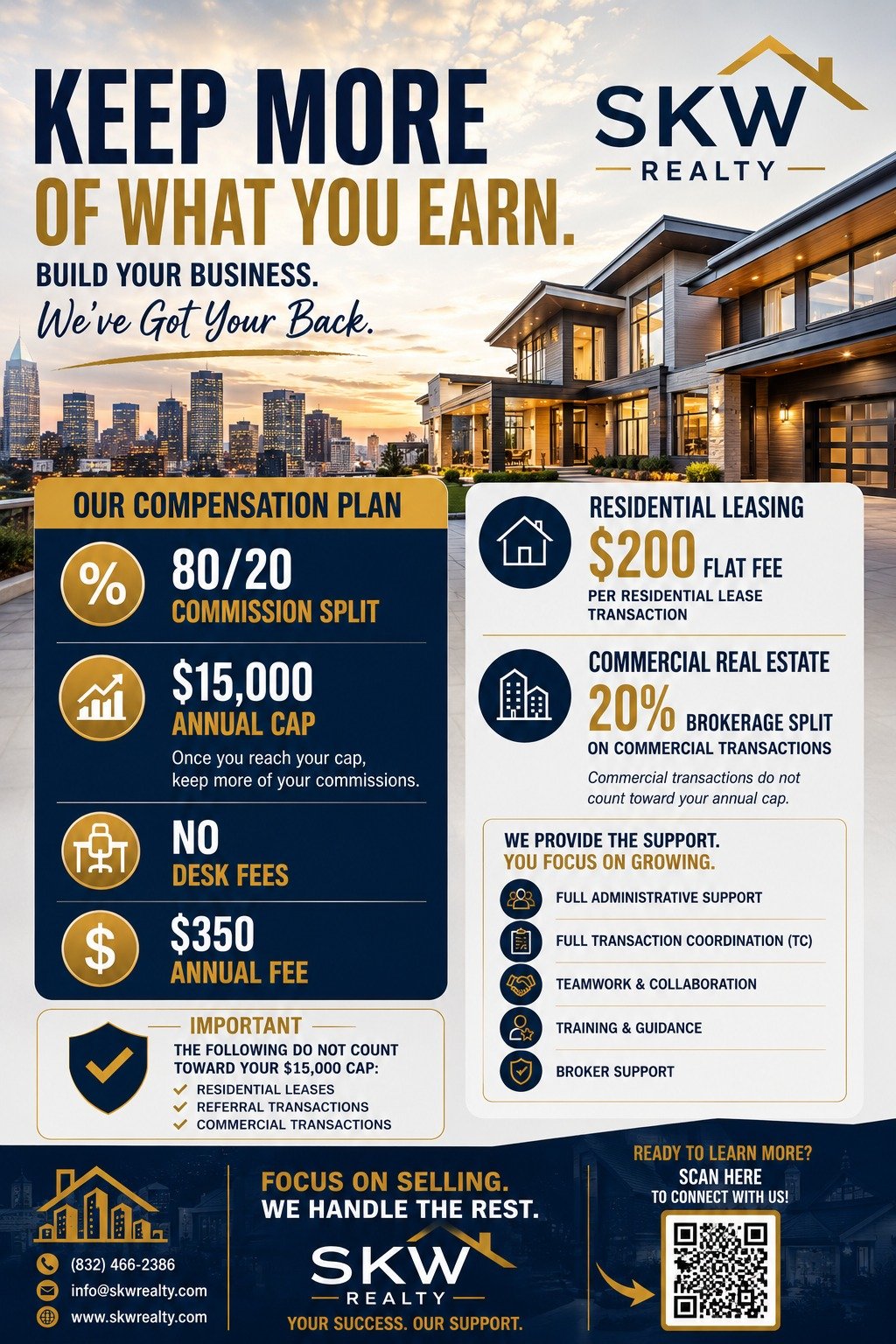
Compensation Plan
Why Agents Are Joining SKW Realty?